| Today's Important News: 07 December 2011 Posted: 07 Dec 2011 02:32 AM PST |
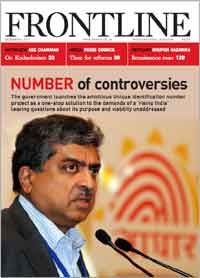
| (Download) Frontline Magazine Dated : November 19 - December 02, 2011 Posted: 07 Dec 2011 12:26 AM PST |
| (IGP) IAS Pre: GS - Indian Polity - Indian Constitution: The Union and It's Territory Posted: 06 Dec 2011 11:13 PM PST 

Indian Polity
The Union and It's Territory Name and territory of the Union: 1. (1) India, that is Bharat, shall be a Union of States.
(2) The States and the territories thereof shall be as specified in the First Schedule.
(3) The territory of India shall comprise—
(a) the territories of the States;
(b) the Union territories specified in the First Schedule; and
(c) such other territories as may be acquired. Admission or establishment of new States. 2. Parliament may by law admit into the Union, or establish, new States on such terms and conditions as it thinks fit. 2A. Sikkim to be associated with the Union. Rep. by the Constitution (Thirty-sixth Amendment) Act, 1975, s. 5 (w.e.f. 26-4-1975). Formation of new States and alteration of areas, boundaries or names of existing States 3. Parliament may by law— (a) form a new State by separation of territory from any State or by uniting two or more States or parts of States or by uniting any territory to a part of any State;
(b) increase the area of any State;
(c) diminish the area of any State;
(d) alter the boundaries of any State;
(e) alter the name of any State: Provided that no Bill for the purpose shall be introduced in either House of Parliament except on the recommendation of the President and unless, where the proposal contained in the Bill affects the area, boundaries or name of any of the States, the Bill has been referred by the President to the Legislature of that State for expressing its views thereon within such period as may be specified in the reference or within such further period as the President may allow and the period so specified or allowed has expired. Explanation I.—In this article, in clauses (a) to (e), "State'' includes a Union territory, but in the proviso, "State'' does not include a Union territory. read more © 2011 www.upscportal.com INTEGRATED Guidance Programme for IAS 2012(CSAT) INTEGRATED Guidance Programme for IAS 2012(CSAT)  :: CSAT Sample Papers :: Current Affairs | CSAT Syllabus | UPSC MAINS PAPERS Get Your Dream Job. SUBMIT YOUR RESUME Online. |
| (IGP) IAS Pre: GS - Indian History - Ancient India : The Harappan Civilization Posted: 06 Dec 2011 11:03 PM PST 

Ancient India
The Harappan Civilization Salient Features: - Urban Civilisation
- Bronze Age Civilisation (Flourished during Circa 2500-2000 B.C.)
- The largest Civilisation in geographical area of the ancient world.
- Town-planning and well developed drainage system.
- Gridiron layout and fortification.
Origin: - Origin lies in various indigenous Pre-Harappan cultures.
- Indus Civilisation was culmination of a long series of cultural evolution.
- Emerged out of the farming communities of Sind and Baluchistan, Haryana Oujarat and Rajasthan.
- Continuous cultural evolution from 6000 BC onwards in North West India which finally culminated in the rise of Indus Civilisation.
Phases of Development: - Archaeological excavation & research have revealed phases of cultural development bursting up in the emergence of a full-fledged civilization at Kalibangan, Banavali and Rakhigarhi.
- Began in Baluchistan & Sind are then extended into the plains.
- These phases are Pre-Harappan, Early Harappan, Mature Harappan and Late Harappan
- Extent of Harrappa:- From in North Manda (J & K) to 1600 k.m Daimabad (Maharastra.) in East Alamgirpur (U.P.) to 1100 K.m Sutkangedor (Bluchistan). Total Area was 12,99,600 Sq. k.m.
- These phases of cultural evolution are represented by Mehargarh, Amri, Kalibangan and Lothal respectively.
Different Phases and Transformation: - Pre-Harappan - Mehargarh - nomadic herdsrnen to settled agriculture
- Early Harappan - Amri - growth of large villages and towns
- Mature Harappan - Kalibangan - rise of great cities
- Late Harappan - Lothal mature as well as decling phase.
Town planning: Facts on Town Planning 1. Features of Town Planning -
A great uniformity in town planning, the fundamental lay-out of prominent urban settlements exhibits apparent similarities. -
Based on 'Grid Pattern': streets and lanes cutting across one another at right angles dividing the city into a number of rectangular blocks. Main streets ran from north to south and were as wide as 30 feet.Streets and lanses were not paved. 2. Entire city complex was bifurcated into two distinct parts: the 'CITADEL' a fortified area which housed important civic and religious public buildings including granaries and residences of the ruling class and the 'LOWER TOWN', somewhat bigger in area and invariably located east to the former, meant. for commoners. Evidence of fortification of the lower towns as well from a few urban centres like Surkotada and Kalibangan and evidence of division of the city into three parts instead of two from Dhaulvira. 3. Use of standardized burnt bricks on massive scale in almost all types of constructions (an extraordinary feature of the contemporary civilizations), circular stones were used at Dholavira. 4. Elaborate andplanned underground drainage system. Houses were connected to the main drain equipped with manholes. Mostly made up of bricks with mud mortar. Use of gypsum and lime to make it watertight. Cesspits were there inside the houses to deposit solid waste. Bricks culverts meant for carrying rain and storm water have also been found. Bricks were made in ratio of I 2 4. Size of Bricks - 7 C.m in Thick, - - 14 C.m Width
- - 28 C.m Long.
5. Features of Houses -
Houses were plain and did not exhibit, any refinement and beauty. So far as the decorative value of the houses was concerned, they lacked it. In general they gave plain and un-decorative look. -
An average house comprised a courtyard and four to six rooms, a bedrooms, a kitchen, and a well presence of staircase gives indication of the second storey. Houses had side-entrances and windows were conspicuously absent. Except Lothal, where enterance were on main road and windows were found. -
Houses varied from a single-roomed tenements to houses with a number of rooms and having even a second storey. Floors were generally of beaten earth coated with cowdung. Fire-places were common in rooms. Walls were thick and square holes in them suggest of use of wooden beams. Every house was separated by another by a narrow space of 'no-man's land'. Staircases were usually wooden but some made up of burnt bricks have been found too. Roofs were flat. Doors were set in wooden frames and the average width of a door was one metre. Square and rectangular pillars of burnt bricks were used in larger rooms, round pillars were absent. Kitchen was small in size. A round oven meant for baking chappatis has been found. Art and Craft: Pottery - Mainly two types Plain pottery and Red and Black Pottery with decoration, the majority being the former.
- Widespread use of potter's wheel made up of wood, use of firing technique, use of kiln.
-
Variety of Pleasing Design — Horizontal strips, Check, Chess-Board Pattern, Interesecting Circles (Pattern exclusively found), Leaves & Petals, Natural Motif — Birds, Fish, Animals, Plants, Human Figure — Rare (A Man & A Child found from Harappa), Triangles. - Pottery had plain bases. Few ring bases have been found.
- Mainly famous colour of pot was pink. General design was on the red base horizontally black line on pots.
Seals - Seals are the greatest artistic creation of the Harappan people — cutting &polishing craftmanship is excellent.
- No of seals discovered is approx. 2000
- Made of steatite (Soft stone), Sometimes of Copper, Shell, Agate, Ivory, Faience, Terracotta.
- Size— 4 inch to 2Y2 inch.
- Shape — Square, Rectangular, Button, Cubical, Cylinder, Round
- Two main types:-
Square — carved animal & inscription, small boss at the back.
Rectangular— inscription only, hold on the back to take a cord. - Colour — White appearance. Famous colour of seal was green.
- Displays symbols - Circles, Crosses, Dots, Swastiks, Leaves of the Pipal tree.
- Most frequently depicted animal - Unicorn
- Other animals : Elephant, Tiger, Rhino, Antelope, Crocodile.
- No bird were depicted on Harappan seal.
- Purpose: Marked ownership of property. Used in applying to bales of merchandise. (Discovery of such seals beside the dockyard of Lothal).
- Pashupati Seal has been found from Mohanjodaro. It depicts Siva seated on a stool flanked by an elephant, a tiger, a. rhinocerous, a buffalo and two antelopes / goats. Marshall identified it with Proto — Siva.
- 'Persian Gulf Seals' have been discovered from Lothal.
read more © 2011 www.upscportal.comINTEGRATED Guidance Programme for IAS 2012(CSAT):: CSAT Sample Papers :: Current Affairs | CSAT Syllabus | UPSC MAINS PAPERS Get Your Dream Job. SUBMIT YOUR RESUME Online. |




No comments:
Post a Comment