Wednesday, 14 December 2011

www.UPSCPORTAL.com : "(IGP) IAS Pre Paper - 2: GS - Logical Reasoning & Analytical Ability - Statement and Arguments (MCQ - 1)" plus 16 more

www.UPSCPORTAL.com : "(IGP) IAS Pre Paper - 2: GS - Logical Reasoning & Analytical Ability - Statement and Arguments (MCQ - 1)" plus 16 more

Link to UPSCPORTAL.COM - Online Community for UPSC, IAS, CSAT, PSC, Civil Services Aspirants.

(IGP) IAS Pre Paper - 2: GS - Logical Reasoning & Analytical Ability - Statement and Arguments (MCQ - 1)

Posted: 14 Dec 2011 03:33 AM PST


Logical Reasoning & Analytical Ability
Statement and Arguments (MCQ - 1)

Directions: In making decisions about important questions, it is desirable to distinguish between "strong" argument and "weak" argument. A "strong" argument must be both important and directly relatedto the question. A"weak" argument may not be directly related to the question andmay be of minor importance or may he related to the trivial aspect of the question. Each question below is followed by twoarguments, numbered I and II. You have to decide which of the arguments is "strong" and which is `weak'. Give answer (a) if only argument I is strong, (b) if only argument II is strong, (c) if neither I nor II is strong and (d) if both I and II are strong.

1. Statement: Should there be capital punishment for those who are found guilty of rape charges

Arguments
I. Yes, this is the only way to eliminate such atrocities on women.
II. No, this will read tomore violence as culprits may even kill the rape victims.


read more

© 2011 www.upscportal.com


INTEGRATED Guidance Programme for IAS 2012(CSAT)


:: CSAT Sample Papers ::

Current Affairs CSAT Syllabus | UPSC MAINS PAPERS


Get Your Dream Job. SUBMIT YOUR RESUME Online.


(IGP) IAS Pre Paper - 2: GS - Logical Reasoning & Analytical Ability - Statement and Arguments

Posted: 14 Dec 2011 02:55 AM PST


Logical Reasoning & Analytical Ability
Statement and Arguments

Such type of questions consist of a Statement followed by certain arguments in favour of or against the Statement. Candidates would be required to distinguish between the strong and weak arguments.

'Strong' arguments are those which are both important and directly related to the question. 'Weak' arguments are those which are of minor importance and also may not be directly related to the question or may be related to a trivial aspect of the question. A weak argument is very simple, superfluous, ambiguous and long drawn one.

Following points should be taken into consideration while choosing a strong argument

  1. A strong argument should give the realistic diagnosis of the situation described in the Statement.
  2. A strong argument should give the deep analysis of the topic deal within the Statement.
  3. A strong argument should relate with the Statement and be supported up by facts or established notions.
  4. A strong argument should not be mere reiteration of the situation given in the Statement.

Following examples will help the students to have an understanding of the logic used to solve these questions.

Types of Questions that could be Asked in CSAT

There are two types of questions which may be asked.

Type 1 Two Arguments Based

In these questions a Statement is followed by two arguments. Candidates are required to distinguish between the strong and weak arguments. Generally both the arguments are contrary to each other and refer to positive and negative results.

Directions (Q. Nos. 1 to 2) Study the instructions carefully and answer the questions that follows. In making decisions about important question it is desirable to be able to distinguish between "strong" and "weak" argument so far as they relate to the questions. "Weak" arguments may not be directly related to the question and may be of minor importance or may be related to the trivial aspect of the question. Each question below is followed by two arguments numbered I and II. You have to decide which of the arguments is a `strong' argument and which is a `weak' argument. Give answer (a) if only argument I is strong, (b) if only argument II is strong, (c) if neither I nor II is strong and (d) if both I and II are strong.


read more

© 2011 www.upscportal.com


INTEGRATED Guidance Programme for IAS 2012(CSAT)


:: CSAT Sample Papers ::

Current Affairs CSAT Syllabus | UPSC MAINS PAPERS


Get Your Dream Job. SUBMIT YOUR RESUME Online.


(IGP) IAS Pre: GS - Indian History - Ancient India : The Mauryan (MCQ - 4)

Posted: 14 Dec 2011 02:33 AM PST


Ancient India
The Mauryan (MCQ - 4)

1. Consider the following statements and mark the option which is correct.
(i) Ashoka the great founded the Mauryana Empire with help of his Brahmin Minister Chankya.
(ii) Asthashastras is contains 15 chapters.
(iii) Magasthenes in his book Indika gives reference to absence of usury.

(a) i, & iii
(b) ii & iii
(c) i & ii
(d) none of the above.


read more

© 2011 www.upscportal.com


INTEGRATED Guidance Programme for IAS 2012(CSAT)


:: CSAT Sample Papers ::

Current Affairs CSAT Syllabus | UPSC MAINS PAPERS


Get Your Dream Job. SUBMIT YOUR RESUME Online.


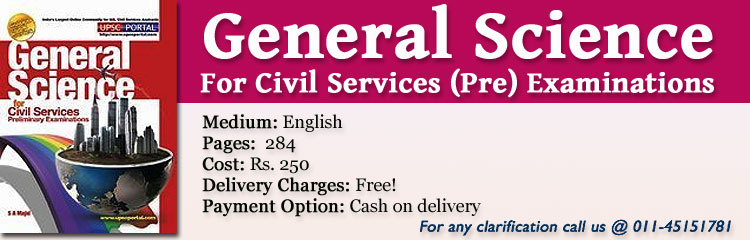
BOOK ORDER FORM : General Science For Civil Services Pre Examination

Posted: 14 Dec 2011 02:28 AM PST


ORDER ONLINE

Buy General Science For Civil Services Preliminary Examinations

General Science For Civil Services Preliminary Examinations

CLICK HERE TO ORDER
 

Order on Phone: Call 1800 102 3547  (Toll Free) - Flipkart.com

BOOK DETAILS

Medium: English
Price: Rs. 250
Pages: 284
Publisher: UPSCPORTAL.COM

TOPICS OF THE BOOK

  • CELL
  • TISSUE
  • MUSCULAR AND SKELETAL SYSTEM
  • THE NERVOUS SYSTEM
  • THE ENDOCRINE SYSTEM
  • LYMPHATIC SYSTEM AND IMMUNITY
  • THE RESPIRATORY SYSTEM
  • THE CIRCULATORY SYSTEM
  • THE INTEGUMENTARY SYSTEM
  • THE REPRODUCTIVE SYSTEM
  • PLANT REPRODUCTIVE SYSTEM
  • PLANT REPRODUCTION
  • THE DIGESTIVE SYSTEM
  • THE EXCRETORY SYSTEM
  • PHOTOSYNTHESIS
  • DIGESTION IN PLANTS
  • DIVERSITY IN LIVING ORGANISMS
  • THE ANIMAL KINGDOM
  • GIST OF PHYSICS FROM NCERT BOOKS
  • GIST OF CHEMISTRY FROM NCERT BOOKS
  • GIST OF WHAT, WHY & HOW
  • INDIA'S NUCLEAR PROGRAMME
  • INDIA'S DEFENCE PROGRAMME
  • INDIA'S SPACE PROGRAMME
  • SCIENCE AND TECHNOLOGICAL DEVELOPMENT IN INDIA
  • UNIVERSE

HELP LINE!

For any Help:
CALL us @  011-45151781
Or Contact us

ORDER MORE BOOKS

read more

© 2011 www.upscportal.com


INTEGRATED Guidance Programme for IAS 2012(CSAT)


:: CSAT Sample Papers ::

Current Affairs CSAT Syllabus | UPSC MAINS PAPERS


Get Your Dream Job. SUBMIT YOUR RESUME Online.


Comparison between Free Integrated Guidance Programme with Paper -2 Study Kit

Posted: 14 Dec 2011 02:06 AM PST


Comparison between Free Integrated Guidance Programme with Paper -2 Study Kit


read more

© 2011 www.upscportal.com


INTEGRATED Guidance Programme for IAS 2012(CSAT)


:: CSAT Sample Papers ::

Current Affairs CSAT Syllabus | UPSC MAINS PAPERS


Get Your Dream Job. SUBMIT YOUR RESUME Online.


Contents of the Study Kit

Free

Paid/Premium

Comprehension http://static.upscportal.com/images/igp/IGP-Correct.jpg http://static.upscportal.com/images/igp/IGP-Correct.jpg
Total MCQs: 500+ 150 500+
English Language Comprehension http://static.upscportal.com/images/igp/IGP-Correct.jpg http://static.upscportal.com/images/igp/IGP-Correct.jpg
Total MCQs: 500+ 150 500+

(Article) FDI in Retail: Civil Services Mentor Magazine December 2011

Posted: 14 Dec 2011 12:59 AM PST


Occupy Movement: Danger Bell is Ringing

Whatever the original impulse behind Occupy Wall Street, or the speculation of what the movement might become, this much is true: The groups of protesters, now camping or hanging out in many U.S. cities, and the police agencies that have responsibility for public safety and order, are both shifting into new postures of action and response. Whether that evolving chemistry will push things toward more confrontation remains unclear. But the combination new participants, new police tactics is clearly opening an uncertain chapter in a story that from its inception has embraced the notion of unplanned, unscripted civil action.

The Occupy movement is an international protest movement which is primarily directed against economic and social inequality. The first Occupy protest to be widely covered was Occupy Wall Street in New York City, taking place on September 17, 2011. By October 9, Occupy protests had taken place or were ongoing in over 95 cities across 82 countries, and over 600 communities in the United States. As of December 1 the Meetup page "Occupy Together" listed 2,686 Occupy communities worldwide. The movement was initiated by the Canadian activist group Adbusters, and partly inspired by the Arab Spring, especially Cairo's Tahrir Square protests, and the Spanish Indignants. The movement commonly uses the slogan We are the 99%, the Occupy hashtag format, and organizes through websites such as "Occupy Together". According to the Washington Post, the movement, which has been described as a "democratic awakening" by Cornel West, is difficult to distill to a few demands.

On May 30, 2011, a leader in the Spanish Indignants movement, inspired by the Arab Spring, made a call for a worldwide protest on October 15. In mid-2011, the Canadian-based group Adbusters Media Foundation, best known for its advertisement-free anti-consumerist magazine Adbusters, proposed a peaceful occupation of Wall Street to protest corporate influence on democracy, address a growing disparity in wealth, and the absence of legal repercussions behind the recent global financial crisis. "One of the inspirations for the movement was the Democracy Village set up in 2010, outside the British Parliament in London. The first protest was held at Zuccotti Park in New York City on September 17, 2011. The phrase "The 99%" is a political slogan used by protesters of the Occupy movement. It was originally launched as a Tumblr blog page in late August of 2011. It refers to the concentration of wealth among the top 1% of income earners compared to the other 99 percent; the top 1 percent of income earners nearly tripled after-tax income over the last thirty years according to a Congressional Budget Office (CBO) report.


read more

© 2011 www.upscportal.com


INTEGRATED Guidance Programme for IAS 2012(CSAT)


:: CSAT Sample Papers ::

Current Affairs CSAT Syllabus | UPSC MAINS PAPERS


Get Your Dream Job. SUBMIT YOUR RESUME Online.


(Article) FDI in Retail: Civil Services Mentor Magazine December 2011

Posted: 14 Dec 2011 12:55 AM PST


FDI in Retail: To be or Not To be.

The Union cabinet on 24 November 2011 approved 51 per cent foreign direct investment (FDI) in multi-brand retail. The Cabinet also decided to raise the cap on foreign investment in single-brand retailing to 100 per cent from 51 per cent. An estimated Rs 30-lakh-crore retail sector was thus opened to foreign investors by clearing a bill that allows 51 per cent investment in multi-brand retail.The decision being perceived as game-changer for the estimated USD 590 billion (Rs 29.50 lakh crore) retail market was taken at the meeting of the Cabinet presided over by Prime Minister Manmohan Singh.

India currently allows 51 percent foreign investment in single-brand retailers and 100 percent for wholesale operations but no FDI in multi-brand retail.
The major provisions for FDI investment include that the minimum investment will have to be $100 million. Retail stores will only be allowed in cities with more than one million people. Also it will be mandatory for retailers to source a minimum 30 per cent of the value of manufactured goods, barring food products, from small and medium enterprises. Investment up to 50 per cent will have to be in storage and back-end infrastructure. India being a signatory to World Trade Organisation's General Agreement on Trade in Services, which include wholesale and retailing services, had to open up the retail trade sector to foreign investment. There were initial reservations towards opening up of retail sector arising from fear of job losses, procurement from international market, competition and loss of entrepreneurial opportunities. FDI in cash and carry or wholesale trade, was allowed way back in 1997 during the United Front Government. Foreign investment of up to 51 per cent in single brand retailing came to India in January 2006.

The Union government further asserted that 30 per cent sourcing under FDI in multi-brand retail has been made mandatory from Indian MSEs only. The government highlighted that the 30 per cent obligation before the global players is limited to India. The government's explanation came amidst protests from the opposition and the micro and small enterprises (MSEs).According to government's previous stand, the overseas players have to do 30 per cent of their sourcing from MSEs which, however, can be done from anywhere in the world and is not India-specific. The only condition placed was that these MSEs must not have more than $1 million [Rs.5 crore] investment in plant and machinery.

In 2004, The High Court of Delhi defined the term 'retail' as a sale for final consumption in contrast to a sale for further sale or processing (i.e. wholesale), A sale to the ultimate consumer. Thus, retailing can be said to be the interface between the producer and the individual consumer buying for personal consumption. This excludes direct interface between the manufacturer and institutional buyers such as the government and other bulk customers Retailing is the last link that connects the individual consumer with the manufacturing and distribution chain. A retailer is involved in the act of selling goods to the individual consumer at a margin of profit.

read more

© 2011 www.upscportal.com


INTEGRATED Guidance Programme for IAS 2012(CSAT)


:: CSAT Sample Papers ::

Current Affairs CSAT Syllabus | UPSC MAINS PAPERS


Get Your Dream Job. SUBMIT YOUR RESUME Online.


(IGP) IAS Pre: GS - Indian History - Ancient India : The Mauryan

Posted: 14 Dec 2011 12:37 AM PST


Indian History
The Mauryan

Chandragupta founded it in 322 B.C. with the help of his Brahmin Minister Chanakya.

References and Sources:

The most important source in Artha Sastra which has 15 chapters called Adhikaranas. Other Sanskrit sources are Kaumudi Mahotsava of Vajika and Mudraraksha of Visakhadutta. Sangam poets
named Mamulnar and Pamar described about Bimba Mauryas attack on South India.


read more

© 2011 www.upscportal.com


INTEGRATED Guidance Programme for IAS 2012(CSAT)


:: CSAT Sample Papers ::

Current Affairs CSAT Syllabus | UPSC MAINS PAPERS


Get Your Dream Job. SUBMIT YOUR RESUME Online.


1. Division of Indian Society into seven castes Megasthenes
2. Absence of slavery Megasthenes
3. Chronology and list of Mauryan Kings Puranas
4. Economic and Political Conditions Arthashastra
5. Social and Economic Conditions Jatakas
6. Role of Ashoka in spreading Buddhism to Sri Lanka Dipvamsa & Mahavamsa
7. Conversion of Chandragupta Maurya to Jainism — his abdication of throne and
going to Sravanbelagola
Parisistparvan of Hemachandra
8 Absence of usury (Money lending) Megasthenes
9. Ashoka's favour to Ajivikas Barabar Hill cave inscriptions
10. Construction of Sudarsana Lake Junagarh Rock Inscription of Rudradaman I.
11. Killing of 99 of his brothers and seizing of throne by Ashoka Mahavamsa & Dipavamsa
12. The name Ashoka Maski Gujarra, Nittur and Udegolam Edicts
13. Existance of an Ashokan Pillar at Sanakisa with a lion capital Fa-hien

Today's Important News: 14 December 2011

Posted: 13 Dec 2011 11:55 PM PST


Today's Important News (14-12-2011)

The Hindu

National:

  1. Broad consensus in UPA on including Prime Minister under Lokpal
  2. Supreme Court tells Kerala, Tamil Nadu not to arouse people's feelings
  3. Mark Tully: India needs great steps to realise its potential
  4. Enough is enough, Manmohan wants to pump in purpose
  5. Decision on Food Security Bill deferred
  6. No CISF deployment without Kerala's request: Manmohan
  7. Centre to set up Rs. 1,000-crore fund to promote housing for poor

read more

© 2011 www.upscportal.com


INTEGRATED Guidance Programme for IAS 2012(CSAT)


:: CSAT Sample Papers ::

Current Affairs CSAT Syllabus | UPSC MAINS PAPERS


Get Your Dream Job. SUBMIT YOUR RESUME Online.


(IGP) IAS Pre: GS - Indian Polity - The Constitution of India: Fundamental Rights (MCQ - 4)

Posted: 13 Dec 2011 11:39 PM PST


Indian Polity
Fundamental Rights  (MCQ - 4)

1. The fundamental rights can be suspended by
a) Parliament
b) President
c) Supreme court
d) President in consultation with supreme court


read more

© 2011 www.upscportal.com


INTEGRATED Guidance Programme for IAS 2012(CSAT)


:: CSAT Sample Papers ::

Current Affairs CSAT Syllabus | UPSC MAINS PAPERS


Get Your Dream Job. SUBMIT YOUR RESUME Online.


(IGP) IAS Pre: GS - Indian Polity - The Constitution of India: Fundamental Rights

Posted: 13 Dec 2011 11:23 PM PST


Indian Polity
Fundamental Rights

General

Definition

12. In this Part, unless the context otherwise requires, "the State'' includes the Government and Parliament of India and the Government and the Legislature of each of the States and all local or other
authorities within the territory of India or under the control of the Government of India.

Laws inconsistent with or in derogation of the fundamental rights.

13. (1) All laws in force in the territory of India immediately before the commencement of this Constitution, in so far as they are inconsistent with the provisions of this Part, shall, to the extent of such inconsistency, be void.

(2) The State shall not make any law which takes away or abridges the rights conferred by this Part and any law made in contravention of this clause shall, to the extent of the contravention, be void.

(3) In this article, unless the context otherwise requires,—
(a) "law" includes any Ordinance, order, bye-law, rule, regulation, notification, custom or usage having in the territory of India the force of law;
(b) "laws in force" includes laws passed or made by a Legislature or other competent authority in the territory of India before the commencement of this Constitution and not previously repealed, notwithstanding that any such law or any part thereof may not be then in operation either at all or in particular areas.
(4) Nothing in this article shall apply to any amendment of this Constitution made under article 368.

Right to Equality

Equality before law.

14. The State shall not deny to any person equality before the law or the equal protection of the laws within the territory of India.

Prohibition of discrimination on grounds of religion, race, caste, sex or place of birth.

15. (1) The State shall not discriminate against any citizen on grounds only of religion, race, caste, sex, place of birth or any of them.
(2) No citizen shall, on grounds only of religion, race, caste, sex, place of birth or any of them, be subject to any disability, liability, restriction or condition with regard to—
(a) access to shops, public restaurants, hotels and places of public entertainment; or
(b) the use of wells, tanks, bathing ghats, roads and places of public resort maintained wholly or partly out of State funds or dedicated to the use of the general public.

(3) Nothing in this article shall prevent the State from making any special provision for women and children.

(4) Nothing in this article or in clause (2) of article 29 shall prevent the State from making any special provision for the advancement of any socially and educationally backward classes of citizens or for the Scheduled Castes and the Scheduled Tribes.

(5) Nothing in this article or in sub-clause (g) of clause (1) of article 19 shall prevent the State from making any special provision, by law, for the advancement of any socially and educationally backward classes of citizens or for the Scheduled Castes or the Scheduled Tribes in so far as such special provisions relate to their admission to educational institutions including private educational institutions, whether
aided or unaided by the State, other than the minority educational institutions referred to in clause (1) of article 30.

Equality of opportunity in matters of public employment.

16. (1) There shall be equality of opportunity for all citizens in matters relating to employment or appointment to any office under the State.

(2) No citizen shall, on grounds only of religion, race, caste, sex, descent, place of birth, residence or any of them, be ineligible for, or discriminated against in respect of, any employment or office under the State.

(3) Nothing in this article shall prevent Parliament from making any law prescribing, in regard to a class or classes of employment or appointment to an office [under the Government of, or any local or other authority within, a State or Union territory, any requirement as to residence within that State or Union territory] prior to such employment or appointment.

(4) Nothing in this article shall prevent the State from making any provision for the reservation of appointments or posts in favour of any backward class of citizens which, in the opinion of the State, is not adequately represented in the services under the State.

(4A) Nothing in this article shall prevent the State from making any provision for reservation [in matters of promotion, with consequential seniority, to any class] or classes of posts in the services under the State in favour of the Scheduled Castes and the Scheduled Tribes which, in the opinion of the State, are not adequately represented in the services under the State.

(4B) Nothing in this article shall prevent the State from considering any unfilled vacancies of a year which are reserved for being filled up in that year in accordance with any provision for reservation made under clause (4) or clause (4A) as a separate class of vacancies to be filled up in any succeeding year or years and such class of vacancies shall not be considered together with the vacancies of the year in
which they are being filled up for determining the ceiling of fifty per cent. reservation on total number of vacancies of that year.

(5) Nothing in this article shall affect the operation of any law which provides that the incumbent of an office in connection with the affairs of any religious or denominational institution or any member of the governing body thereof shall be a person professing a particular religion or belonging to a particular denomination.

Abolition of Untouchability.

17. "Untouchability" is abolished and its practice in any form is forbidden. The enforcement of any disability arising out of "Untouchability" shall be an offence punishable in accordance with law.

Abolition of titles.

18. (1) No title, not being a military or academic distinction, shall be conferred by the State.

(2) No citizen of India shall accept any title from any foreign State.

(3) No person who is not a citizen of India shall, while he holds any office of profit or trust under the State, accept without the consent of the President any title from any foreign State.

(4) No person holding any office of profit or trust under the State shall, without the consent of the President, accept any present, emolument, or office of any kind from or under any foreign State.

Right to Freedom

Protection of certain rights regarding freedom of speech, etc.

19. (1) All citizens shall have the right—
(a) to freedom of speech and expression;
(b) to assemble peaceably and without arms;
(c) to form associations or unions;
(d) to move freely throughout the territory of India;
(e) to reside and settle in any part of the territory of India; and
(g) to practice any profession, or to carry on any occupation, trade or business.

(2) Nothing in sub-clause (a) of clause (1) shall affect the operation of any existing law, or prevent the State from making any law, in so far as such law imposes reasonable restrictions on the exercise of the right conferred by the said sub-clause in the interests of the sovereignty and integrity of India, the security of the State, friendly relations with foreign States, public order, decency or morality, or in relation to contempt of court, defamation or incitement to an offence.

(3) Nothing in sub-clause (b) of the said clause shall affect the operation of any existing law in so far as it imposes, or prevent the State from making any law imposing, in the interests of the sovereignty and integrity of India or public order, reasonable restrictions on the exercise of the right conferred by the said sub-clause.

(4) Nothing in sub-clause (c) of the said clause shall affect the operation of any existing law in so far as it imposes, or prevent the State from making any law imposing, in the interests of the sovereignty and integrity of India or public order or morality, reasonable restrictions on the exercise of the right conferred by the said sub-clause.

(5) Nothing in [sub-clauses (d) and (e)] of the said clause shall affect the operation of any existing law in so far as it imposes, or prevent the State from making any law imposing, reasonable restrictions on the exercise of any of the rights conferred by the said sub-clauses either in the interests of the general public or for the protection of the interests of any Scheduled Tribe.

(6) Nothing in sub-clause (g) of the said clause shall affect the operation of any existing law in so far as it imposes, or prevent the State from making any law imposing, in the interests of the general public, reasonable restrictions on the exercise of the right conferred by the said sub-clause, and, in particular, nothing in the said sub-clause shall affect the operation of any existing law in so far as it relates to, or prevent the State from making any law relating to,—
(i) the professional or technical qualifications necessary for practising any profession or carrying on any occupation, trade or business, or
(ii) the carrying on by the State, or by a corporation owned or controlled by the State, of any trade, business, industry or service, whether to the exclusion, complete or partial, of citizens or otherwise.


read more

© 2011 www.upscportal.com


INTEGRATED Guidance Programme for IAS 2012(CSAT)




:: CSAT Sample Papers ::

Current Affairs CSAT Syllabus | UPSC MAINS PAPERS


Get Your Dream Job. SUBMIT YOUR RESUME Online.


(IGP) IAS Pre: GS - Indian Polity - The Constitution of India: The Union and It's Territory (MCQ - 2)

Posted: 13 Dec 2011 10:45 PM PST


Indian Polity
The Union and It's Territory (MCQ - 2)

1. The Union territories are specified in the _____ schedule
(a) 2nd
(b) 1st
(c) 3rd
(d) 4th


read more

© 2011 www.upscportal.com


INTEGRATED Guidance Programme for IAS 2012(CSAT)


:: CSAT Sample Papers ::

Current Affairs CSAT Syllabus | UPSC MAINS PAPERS


Get Your Dream Job. SUBMIT YOUR RESUME Online.


(IGP) IAS Pre: GS - Indian Polity - The Constitution of India: Preamble (MCQ - 1)

Posted: 13 Dec 2011 10:38 PM PST


Indian Polity
Preamble (MCQ - 1)

1. The constitution assembly adopted the constitution on.
(a) Twenty sixth day of January, 1950
(b) Twenty sixth day of November, 1949
(c) Twenty sixth day of January, 1949
(d) None of the above.


read more

© 2011 www.upscportal.com


INTEGRATED Guidance Programme for IAS 2012(CSAT)


:: CSAT Sample Papers ::

Current Affairs CSAT Syllabus | UPSC MAINS PAPERS


Get Your Dream Job. SUBMIT YOUR RESUME Online.


(IGP) IAS Pre: GS - Indian Polity - The Constitution of India: Citizenship (MCQ - 3)

Posted: 13 Dec 2011 10:33 PM PST


Indian Polity
Citizenship (MCQ - 3)

1. A person is entitled to Indian citizenship if
(a) Domiciled in India
(b) Born in India
(c) A refuge who has migrated to India form Pakistan
(d) All of the above


read more

© 2011 www.upscportal.com


INTEGRATED Guidance Programme for IAS 2012(CSAT)


:: CSAT Sample Papers ::

Current Affairs CSAT Syllabus | UPSC MAINS PAPERS


Get Your Dream Job. SUBMIT YOUR RESUME Online.


(IGP) IAS Pre: GS - Indian Polity - The Constitution of India: Citizenship

Posted: 13 Dec 2011 10:13 PM PST


Indian Polity
Citizenship

Citizenship at the commencement of the Constitution.

5. At the commencement of this Constitution, every person who has his domicile in the territory of India and—
(a) who was born in the territory of India; or
(b) either of whose parents was born in the territory of India; or
(c) who has been ordinarily resident in the territory of India for not less than five years immediately preceding such commencement, shall be a citizen of India.

Rights of citizenship of certain persons who have migrated to India from Pakistan.

6. Notwithstanding anything in article 5, a person who has migrated to the territory of India from the territory now included in Pakistan shall be deemed to be a citizen of India at the commencement of this Constitution if—
(a) he or either of his parents or any of his grandparents was born in India as defined in the Government of India Act, 1935 (as originally enacted); and
(b) (i) in the case where such person has so migrated before the nineteenth day of July, 1948, he has been ordinarily resident in the territory of India since the date of his migration, or
(ii) in the case where such person has so migrated on or after the nineteenth day of July, 1948, he has been registered as a citizen of India by an officer appointed in that behalf by the Government
of the Dominion of India on an application made by him therefore to such officer before the commencement of this Constitution in the form and manner prescribed by that Government:

Provided that no person shall be so registered unless he has been resident in the territory of India for at least six months immediately preceding the date of his application.

Rights of citizenship of certain migrants to Pakistan.

7. Notwithstanding anything in articles 5 and 6, a person who has after the first day of March, 1947, migrated from the territory of India to the territory now included in Pakistan shall not be deemed to be a citizen of India:

Provided that nothing in this article shall apply to a person who, after having so migrated to the territory now included in Pakistan, has returned to the territory of India under a permit for resettlement or permanent return issued by or under the authority of any law and every such person shall for the purposes of clause (b) of article 6 be deemed to have migrated to the territory of India after the nineteenth
day of July, 1948.

Rights of citizenship of certain persons of Indian origin residing outside India.

8. Notwithstanding anything in article 5, any person who or either of whose parents or any of whose grandparents was born in India as defined in the Government of India Act, 1935 (as originally enacted), and who is ordinarily residing in any country outside India as so defined shall be deemed to be a citizen of India if he has been registered as a citizen of India by the diplomatic or consular representative of India in the country where he is for the time being residing on an application made by him therefore to such diplomatic or consular representative, whether before or after the commencement of this Constitution, in the form and manner prescribed by the Government of the Dominion of India or the Government of India.


read more

© 2011 www.upscportal.com


INTEGRATED Guidance Programme for IAS 2012(CSAT)


:: CSAT Sample Papers ::

Current Affairs CSAT Syllabus | UPSC MAINS PAPERS


Get Your Dream Job. SUBMIT YOUR RESUME Online.


(Result) UPSC Engineering Services Exam, 2011 (Written Part)

Posted: 13 Dec 2011 04:51 AM PST


http://lh6.ggpht.com/_XpcuWNz7k5Y/TFlmlmviicI/AAAAAAAACwI/EGd2CxJi1R8/PIB.jpg

The UPSC has announced the result of the written part of the Engineering Services Examination 2011, held in May, 2011. A total of 2158 candidates have qualified which includes 87 physically handicapped category candidates.

The candidature of all these candidates who have qualified for interview/personality test, is provisional subject to their being found eligible in all respects. The candidates would be required to produce the original certificates in support of their claims relating to age, educational qualifications, community, physical disability etc. at the time of the Personality Test. They are, therefore, advised to keep the said certificates ready.

Interview of candidates who have qualified for the Personality Test are likely to be held in the month of January & February, 2012. The exact date of interview will, however, be intimated to the candidates through Interview Letter. Roll Number wise Interview Schedule will also be made available on Commission's Website by last week of December, 2011.

No request for change in the date and time of the Personality Test intimated to the candidates will be entertained under any circumstances.

In accordance with the Rules of examination all these candidates are required to fill up the Detailed Application Form (D.A.F.) which is available on the Commission's Website http://www.upsc.gov.in. All the qualified candidates are required to fill up the DAF and submit the same ON LINE. The DAF will be available on the website of the Commission till 25.12.2011. Important instructions regarding filling up of the DAF and submitting the same ONLINE to the Commission are also available on the website. The candidates who have been declared successful have to first get themselves registered on the relevant page of the website before filling up the ONLINE Detailed Application Form. The qualified candidates are further advised to refer to the Rules of the Engineering Services Examination, 2011 published in the gazette of India, dated 8.1.2011, which is also available on the website of the Commission.

After submitting the DAF duly filled in ONLINE, the candidates are required to take out a print out of the finally submitted DAF separately and will have to send the printed copy of the DAF duly signed (by the candidate) alongwith all relevant documents to the Under Secretary (Engineering), Union Public Service Commission, Dholpur House, Shahjahan Road, New Delhi-110069, so as to reach the Commission's Office latest by 29.12.2011. The envelope containing the print out of the DAF submitted ONLINE should be superscribed "DAF for Engineering Services Examination, 2011." It can also be delivered at UPSC by hand till 29.12.2011 (5.00 P.M.).


read more

© 2011 www.upscportal.com


INTEGRATED Guidance Programme for IAS 2012(CSAT)


:: CSAT Sample Papers ::

Current Affairs CSAT Syllabus | UPSC MAINS PAPERS


Get Your Dream Job. SUBMIT YOUR RESUME Online.


(Download) Free Digital Magazine: Civil Services Mentor, December 2011

Posted: 13 Dec 2011 04:36 AM PST


Free Digital Magazine: Civil Services Mentor, December 2011

Issue : December 2011
Size:
3.5 MB
File Type:
Zipped PDF
Publisher :
 UPSCPORTAL.COM 

Table of Contents:

Articles:

  • FDI in Retail
  • Occupy Movement

Current Affairs:

  • National Issues

  • International Issues

  • Economy

  • India & The World

  • Science & Technology

  • Sports

  • Awards & Prizes

  • Persons in News

Study Material

  • SCRA Exam Solved Practice Paper

read more

© 2011 www.upscportal.com


INTEGRATED Guidance Programme for IAS 2012(CSAT)


:: CSAT Sample Papers ::

Current Affairs CSAT Syllabus | UPSC MAINS PAPERS


Get Your Dream Job. SUBMIT YOUR RESUME Online.


No comments:

Post a Comment